Finding Purpose in Life: What the Research Measures, and How Purpose Is Built
Purpose in life is not an object you find. In the research it is a measured trait, the extent to which you experience your life as directed and motivated by goals you actually value, scored on a scale rather than possessed or lacked, and trials show that score can be raised. So it is built rather than discovered. That is why the phrase gives the wrong instruction. "Finding purpose in life" describes a search for something that already exists, hidden somewhere, waiting to be uncovered by enough reflection. That is not what the research is describing when it measures purpose, and it is not how the people who score highly on those measures got there.
Last reviewed September 22, 2026.
The short answer
Purpose in life, as researchers measure it, is the extent to which you experience your life as directed and motivated by goals you actually value. It is a trait score, not a revelation. It is associated with living longer, fewer cardiovascular events, less hospital time and a lower rate of cognitive decline, all in observational data. And the important part for anyone reading this at forty-five: trials show it can be raised, which means it is constructed rather than discovered. You build one by attaching sustained effort to something outside yourself and keeping it long enough to become the shape of your week.
What "purpose in life" actually means in the research
The construct has a working definition, and it is narrower than the word in ordinary speech. Eric Kim, who has published much of the recent work in this area, puts it as "the extent to which people experience their lives as being directed and motivated by valued life goals", quoted in Harvard Health's write up of the purpose and longevity evidence.
Three things follow from that definition, and each one contradicts a piece of common advice.
It is about direction, not intensity of feeling. The measures ask whether your days point somewhere. They do not ask whether you feel passionate, fulfilled or excited. A man can score high on purpose during a grim year and low on purpose during a pleasant one.
It has goals inside it, but it is not a goal. Valued life goals are the mechanism. The purpose is the ongoing sense of being aimed by them, which is why it does not complete when a target is hit.
It is graded, not binary. Nobody either has purpose or lacks it. The studies below all work with a score on a scale, and they compare people higher on that scale to people lower on it. That matters, because it means the practical question is not "what is my purpose" but "what would move my score".
Much of the foundational data comes from long running national panels rather than one off surveys. Midlife in the United States, the national longitudinal study run out of the University of Wisconsin, began in 1995 with a national probability sample of 3,487 adults plus oversamples, siblings and twin pairs, and has followed the same people since. When you read that purpose predicts an outcome "over fourteen years", that is the kind of infrastructure producing it.
Purpose, meaning, happiness and goals are four different things
Most confusion about this subject is a vocabulary problem. These four words get used interchangeably and they behave differently.
| Term | What it refers to | How you would know you have it | Completes? |
|---|---|---|---|
| Purpose | Your life being directed and motivated by valued goals | Your ordinary week has a shape you did not have to argue yourself into | No |
| Meaning | Your life making sense as a coherent story | You can explain why the hard parts were worth it | No |
| Happiness | Your current affective state | You feel good right now | Constantly |
| A goal | A specific target with a finish line | You hit it or you did not | Yes |
The practical consequence of the last column is the one worth carrying. Stack goals in the slot where a purpose belongs and you run out of road at every success, which is why clearing a large target at forty-five so often lands as deflation rather than arrival. We treat that specific collapse in the midlife reckoning.
What a sense of purpose is associated with
Three pieces of evidence carry most of the weight here. They use different samples, different outcomes and different methods, which is the reason to take them seriously as a set rather than individually.
| Study | Population and analytic sample | Outcome measured | Result |
|---|---|---|---|
| Cohen, Bavishi and Rozanski, 2016, meta-analysis of 10 prospective studies | 136,265 participants pooled | All cause mortality and cardiovascular events | Adjusted pooled relative risk 0.83 for both |
| Kim, Strecher and Ryff, 2014, Health and Retirement Study | 7,168 US adults over 50, tracked 6 years | Preventive service use and hospital nights | 17% fewer hospital nights per scale point, rate ratio 0.83 |
| Boyle and colleagues, 2010, Rush Memory and Aging Project | 951 community dwelling older adults, up to 7 years | Incident Alzheimer disease | Hazard ratio 0.48 for greater purpose |
The meta-analysis is the headline. Pooling ten prospective studies, purpose in life and its relationship to all cause mortality and cardiovascular events found an adjusted pooled relative risk of 0.83 for all cause mortality and 0.83 for cardiovascular events. Subgroup analyses by country, by which questionnaire was used, by age, and by whether people already had cardiovascular disease at baseline all pointed the same way.
The behavioural mechanism shows up clearly in the Health and Retirement Study work. In purpose in life and use of preventive health care services, 7,168 adults over fifty were tracked for six years. Each one point increase on a six point purpose scale was associated with a higher likelihood of getting a cholesterol test, odds ratio 1.18, and for men a higher likelihood of a prostate examination, odds ratio 1.31. Each point was also associated with 17 percent fewer nights spent in hospital. People who feel aimed at something take care of the machine that gets them there.
The cognitive finding is the most striking of the three and also the most population specific. In the Rush Memory and Aging Project, purpose in life was tested against risk of incident Alzheimer disease in community dwelling older people without dementia. Of 951 participants, 155 developed Alzheimer disease over follow up averaging four years. Greater purpose carried a hazard ratio of 0.48, and the authors put it in plainer terms: someone at the 90th percentile of purpose was roughly 2.4 times more likely to remain free of Alzheimer disease than someone at the 10th percentile. The association survived adjustment for depressive symptoms, neuroticism, social network size and chronic medical conditions, and purpose was also associated with reduced risk of mild cognitive impairment, hazard ratio 0.71.
What the evidence does not say
This is where most writing on the subject quietly inflates, so it is worth being exact about the limits.
These are observational studies, and the researchers say so. The strongest available design here follows people over time and adjusts for confounders. It cannot establish that purpose caused the outcome. People who score high on purpose are plausibly healthier in other ways that the statistical adjustment cannot fully strip out. The direction is consistent across independent samples, which is meaningful, and it is still association.
Purpose did not protect against everything. In a 2019 analysis of the association between life purpose and mortality among US adults older than 50, covering nearly 7,000 people, higher purpose was associated with lower death rates overall and from cardiovascular and digestive conditions. Researchers found no association with death from cancer, tumours or respiratory conditions. A protective factor with a ceiling is a more credible one than a universal shield, and anyone selling you the shield is selling.
The populations are mostly older than this site's readers. Two of the three studies above sampled adults over fifty, and the Alzheimer work sampled older adults in senior housing and residences around Chicago whose average age was well beyond midlife. Their findings are about people further along than a man of forty-three. The meta-analysis included age as a subgroup variable and found similar results across the range, which is the best available answer, and it is an inference rather than a direct measurement of men in their forties.
Nobody has shown that a purpose exercise on a Tuesday extends your life. What the trials show is narrower and still useful, and it is the subject of the next section.
Why "finding" is the wrong verb
The clearest signal comes from the 2014 PNAS paper, whose authors state that an increasing number of randomised controlled trials show purpose in life can be raised. Be precise about how much weight that carries: it is a characterisation of a trial literature made in the discussion section of a study about something else, not a single well powered trial with an effect size you can quote, and it is weaker evidence than the mortality and hospital figures above. It is still the right shape of evidence for the question. A hidden object cannot be raised. A score can.
Three practical implications, and they run against most of what gets written about this.
You have already searched, and the search is not the missing input. Two decades of adult life is a long look around the room. If purpose were an object lying in it, you would have tripped over it. Another round of reflection adds nothing that the previous thousand rounds did not.
Feeling follows commitment rather than preceding it. This one is our inference rather than a finding from the studies above: people tend to become invested in things they are competent at and that visibly land on someone. Waiting to feel certain before committing puts the sequence backwards, and it is a comfortable place to wait indefinitely.
The measurement itself points outward. Valued goals that organise a week almost always have another party at the far end of them. This is why purpose and isolation move together, and why a man whose social structure has quietly emptied out finds the question unanswerable. That collapse has its own evidence base in the male loneliness epidemic.
The four places purpose attaches
A purpose has to hang on something, and in practice there are only a few hooks. Each carries a different cost of being wrong, which is the useful way to sequence them.
A person is the cheapest and the most neglected. It requires no resignation, no relocation, no announcement. It requires deciding whose life is measurably different because of your attention, and then arranging your week so that is true.
A craft supplies the part a person cannot: an external standard. Something where you are getting better and where the judgment of quality is not your own opinion. Our editorial read, offered as observation rather than finding: a man competent at nothing outside paid work will usually call the resulting flatness boredom, when it behaves more like unemployment of the hands.
An institution outlasts whoever is currently maintaining it. A team, a trade, a club, a congregation, an accumulated body of work. The National Institute on Aging's summary of what we know about healthy aging makes the adjacent point from the health side about staying socially and intellectually engaged. Institutions are the machinery that makes engagement recur without you having to feel like it.
A belief is the one nobody can hand you, and it is the only one of the four that is not testable on a schedule. It shows up when a commitment and your comfort collide. What you actually leave behind, and whether any of it transfers, is a separate question with its own evidence in what is my legacy.
How to tell which one is missing
Before the diagnostic, one filter: if you are running on serious sleep debt, or the flatness has been total for weeks, the exercise below will read as an indictment rather than information, and the two conditions in the next section apply to you first. Read that section, then come back.
Otherwise this is faster than the introspection people usually attempt, because it asks about last week rather than about your soul.
Reconstruct the week you just lived and write a name beside each block of it. A real name, not a category, and not somebody you intended to get to. The test is whether one specific person's Tuesday went differently because of you. Done truthfully, the exercise usually returns an employer and a vague debt owed to some later version of yourself, with no individual appearing anywhere in the column. The blank column is the finding, and it accounts for more of the midlife dead feeling than any theory of meaning does.
Then check which of the four boxes above returned a name. A blank in the person box and a full craft box produces a competent, admired, lonely man. A full person box and a blank craft box produces someone who is needed constantly and is slowly disappearing. Blanks in three of four is the state most often mistaken for a crisis of identity, when it is closer to a structural vacancy.
Fill exactly one, at the smallest testable size. Not "be more present", which cannot be kept because it cannot be checked. Something with a day and a boundary attached, which can be kept and can also be failed. The failure condition is what makes it real. Concretely, one line each:
- A person. Call your brother every Sunday at six, for eight weeks, and ask him one question you do not already know the answer to.
- A craft. Thursday 7pm to 9pm at the bench, phone in another room, one project finished before the next one starts.
- An institution. Take the fixtures secretary job at the club for one season, the unglamorous one nobody wants.
- A belief. Give a fixed sum on the first of every month, before anything else leaves the account.
Each of those has a day, a boundary and a way to fail. "Be a better father" has none of the three.
If you are already past forty and want the age specific version of this method, with the sequencing and the ninety day rule, that is the subject of finding purpose after 40, which covers the practical protocol rather than the construct.
Two conditions where none of this will work
Chronic depletion flattens the scale itself. Fatigue that has been accumulating for months is a physiological state rather than a verdict on what your life is worth, and no reflective exercise reaches it. Under sustained sleep debt every candidate direction reads as equally grey, which feels like clear eyed judgment and is closer to a broken instrument. Fix the sleep and the load first. Only then is the reading worth trusting.
Total, unlifting flatness belongs with a clinician rather than an article. When interest drains out of every part of life for weeks at a stretch, and sleep or appetite or the ability to concentrate go with it, that cluster has a name and an evidence based treatment behind it. Depression is ordinary among men of this age and it is one of the more treatable things a doctor sees. Book the appointment instead of reading further. The options, and what the evidence actually says about each of them, are set out in therapist for a midlife crisis. For immediate crisis support in the United States, call or text 988. In the United Kingdom, call 116 123.
Where this leaves the question
The search framing fails because it makes you the terrain and the answer the buried object. The measurement framing works better because it makes purpose a score, and scores move. What moves it is attaching effort to something outside yourself and keeping it long enough that your week takes a shape you did not have to argue yourself into every Monday.
That is not an inspiring instruction. It is a small, dull, repeatable one, and the evidence sits behind the dull version rather than the inspiring one.
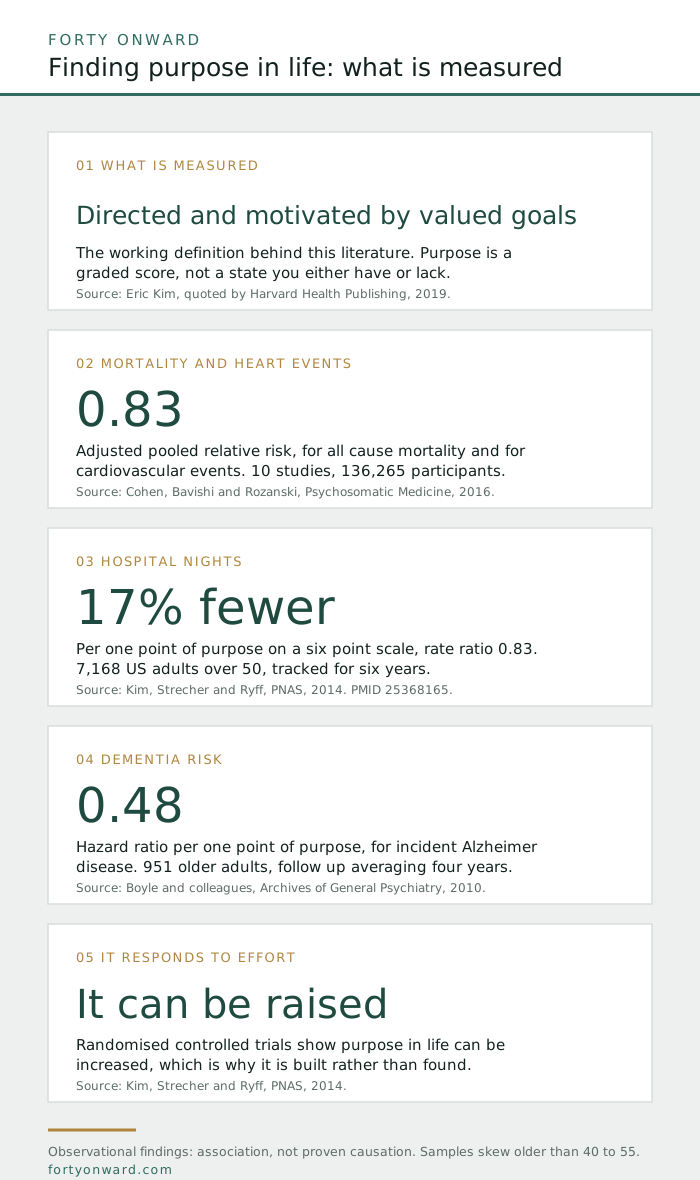
Purpose in one picture
Test yourself
Key takeaways
FAQ
What does purpose in life mean in psychological research?
Purpose in life is the extent to which a person experiences their life as directed and motivated by goals they value. Eric Kim, who has published much of the recent evidence, defines it that way, and the measures used in the major studies score it on a scale rather than treating it as something you either have or lack. It is distinct from happiness, which is a current emotional state, and from a goal, which has a finish line. Purpose does not complete when a target is reached, which is why it keeps organising ordinary weeks in a way that goals do not.
Does having a sense of purpose actually make you live longer?
The association is well established and causation is not. A 2016 meta-analysis pooling ten prospective studies and 136,265 participants found an adjusted pooled relative risk of 0.83 for all cause mortality and 0.83 for cardiovascular events among people with higher purpose. Subgroup analyses by country, age, questionnaire used and baseline cardiovascular disease all produced similar results. These are observational designs, so purposeful people may differ in other ways that also extend life. The consistency across independent samples is the strongest part of the case.
Can a sense of purpose be increased, or are you born with it?
It can be increased. The authors of the Health and Retirement Study work on purpose and preventive health care note that an increasing number of randomised controlled trials show purpose in life can be raised. That is the single most useful fact in this literature, because it means purpose behaves like a score that responds to what you do rather than a fixed trait or a hidden object waiting to be discovered.
What is the difference between purpose and meaning?
Purpose is about direction, whether your life is being aimed by goals you value. Meaning is about coherence, whether your life makes sense as a story, including the difficult parts. A man can have a clear direction and still find his history incoherent, and he can have made sense of his history while having nowhere to point next. They are measured separately and they fail separately.
Does purpose protect against every health problem?
No, and the boundary is documented. In a 2019 JAMA Network Open analysis of nearly 7,000 US adults older than 50, higher purpose was associated with lower death rates overall and from cardiovascular and digestive conditions. Researchers found no association with death from cancer, tumours or respiratory conditions. Treat any claim that purpose protects against everything as overstating what the data supports.
How do I find purpose in life if nothing interests me anymore?
Three different states hide behind that sentence and each calls for a different response. Long running fatigue suppresses interest in everything, so if you are running on empty, repairing sleep and workload comes before any decision about direction. If the deadness is total, has persisted for weeks and arrives alongside disrupted sleep, appetite or concentration, that is a clinical picture and a doctor is the correct next step. If neither fits, the problem is structural rather than emotional. Rebuild last week on paper, put a real name beside each block of it, and see whether any individual appears at all. Then take the cheapest attachment point available, which is one person whose situation is genuinely different because of your attention, and make a commitment narrow enough to carry a day and narrow enough to break.
Is the research on purpose relevant to men in their forties?
Partly, and the honest answer includes a caveat. Two of the three strongest studies sampled adults over fifty, and the Alzheimer disease work sampled community dwelling older adults whose average age was well beyond midlife. The 2016 meta-analysis examined age as a subgroup variable and found similar results across the range, which is the best available evidence that the relationship is not confined to old age. It remains an inference from older samples rather than a direct measurement of men aged forty to fifty five.
Do I have to change careers to build a sense of purpose?
Usually not, and it is the most expensive place to start. Purpose problems get misdiagnosed as job problems, since work is the one part of the week nobody can pretend not to notice. The cheaper tests come first: one person, one craft, one institution. If those are all filled and the work is still dead weight after a season of honest effort, then the career question is real and deserves its own plan rather than a resignation.
Sources
- Cohen R, Bavishi C, Rozanski A. Purpose in Life and Its Relationship to All-Cause Mortality and Cardiovascular Events: A Meta-Analysis. Psychosomatic Medicine, 2016. Ten prospective studies, 136,265 participants pooled. PMID 26630073.
- Kim ES, Strecher VJ, Ryff CD. Purpose in life and use of preventive health care services. Proceedings of the National Academy of Sciences, 2014. Health and Retirement Study, analytic sample 7,168 US adults over 50, tracked six years. PMID 25368165.
- Boyle PA, Buchman AS, Barnes LL, Bennett DA. Effect of a purpose in life on risk of incident Alzheimer disease and mild cognitive impairment in community-dwelling older persons. Archives of General Psychiatry, 2010. Rush Memory and Aging Project, 951 participants analysed, follow up averaging four years. PMID 20194831.
- Alimujiang A and colleagues. Association Between Life Purpose and Mortality Among US Adults Older Than 50 Years. JAMA Network Open, 2019. Analytic sample of 6,985 Health and Retirement Study participants. Source of the cause-specific null findings. PMID 31125099.
- Harvard Health Publishing. Will a purpose-driven life help you live longer? Harvard Medical School, 2019. Source of the Eric Kim definition and of the cause-specific null findings.
- Midlife in the United States (MIDUS), University of Wisconsin. National longitudinal study begun 1995, national probability sample of 3,487 plus oversamples, siblings and twin pairs.
- National Institute on Aging. What do we know about healthy aging? National Institutes of Health.