Finding Purpose After 40 Without Blowing Up Your Life
Purpose sounds like a soft word. It is not. It is one of the more heavily studied variables in adult development, and it shows up in the hardest outcome researchers measure, which is whether you are alive at the end of the follow-up period.
That is worth sitting with before the rest of this. The question of what your life is pointed at is not a luxury concern for men with spare time. It behaves like a health variable.
Last reviewed August 3, 2026.
What the research actually found
Patrick Hill and Nicholas Turiano used the longitudinal Midlife in the United States sample to ask whether purpose predicts survival. It did. Purposeful individuals lived longer than their counterparts over the fourteen years following the baseline assessment, and the effect held even when controlling for other markers of psychological and affective wellbeing.
The detail that matters most for a man in his forties is what the benefit did not depend on. It was not conditional on the participants' age, nor on how long they lived during follow up, nor on whether they had retired from the workforce. As the authors put it, purpose appears to buffer against mortality risk across the adult years.
A separate team at the University of Michigan reached a similar place from different data. Analysing thousands of participants over fifty in the Health and Retirement Study, they examined the association between life purpose and mortality among US adults, noting in their framing that a growing body of literature ties a strong sense of purpose to improvements in physical and mental health.
Both analyses draw on long running national studies rather than one-off surveys. Hill and Turiano's data comes from Midlife in the United States, the national longitudinal study of health and wellbeing in midlife run out of the University of Wisconsin, which has been following the same participants across decades.
These are observational findings, so the honest reading is association rather than proof of cause. Purposeful people may differ in other ways that also extend life. But the direction is consistent across independent samples, and the practical implication is unchanged: this is not a decorative question.
Why "find your passion" fails men at forty
The standard instruction assumes purpose is a hidden object, buried somewhere inside you, and that the task is excavation. Sit with it long enough and it surfaces.
For a man at forty-five this fails for three specific reasons.
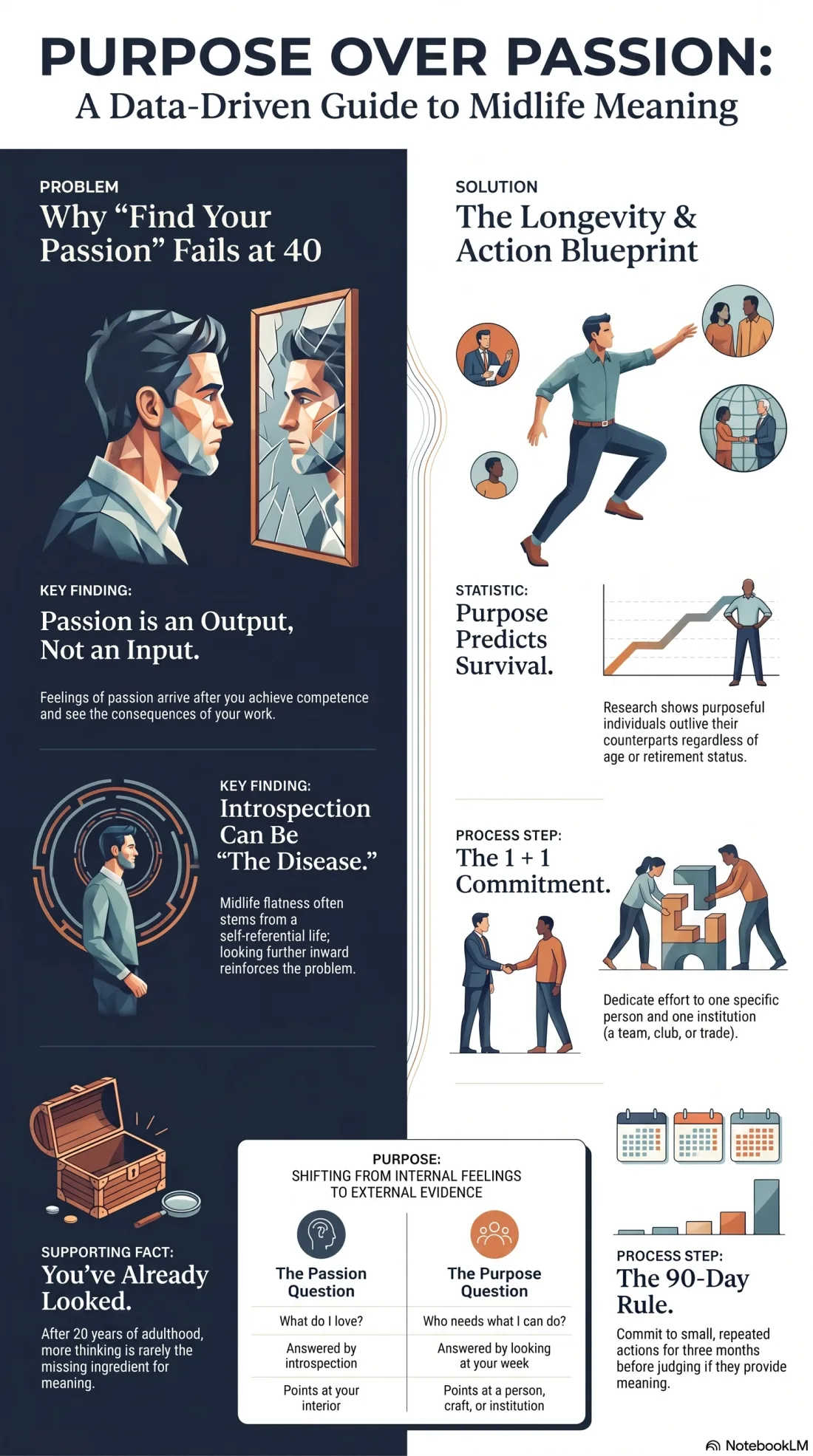
You have already looked. Twenty years of adult life is a long search. If it were lying around waiting to be noticed, you would have tripped over it by now. More introspection is not the missing ingredient.
Passion is an output, not an input. People become passionate about things they are good at and that visibly matter to somebody. The feeling arrives after the competence and the consequence, not before them. Waiting to feel it before you act is waiting in the wrong order.
It points inward, at the exact moment inward is the problem. The flatness in the middle is very often a symptom of a life that has become entirely self referential: your career, your performance, your legacy. The instruction to look further inside is more of the disease presented as the cure.
The better question
Replace "what is my passion" with a harder and more answerable one:
Who is worse off if I do not do this?
Purpose in the research literature is directional. It means having aims that organise your behaviour and give days a shape. Aims like that almost always have somebody on the other end. What the scales actually ask, and what that evidence does and does not establish, is set out in finding purpose in life.
This reframing does most of the work, because it is answerable with evidence rather than feeling. You can look at your week and see who your effort actually lands on.
| The passion question | The purpose question |
|---|---|
| What do I love? | Who needs what I can do? |
| Answered by introspection | Answered by looking at your week |
| Feels like it should arrive as certainty | Arrives as a small obligation you keep |
| Fails when you feel flat | Works when you feel flat, which is when you need it |
| Points at your interior | Points at a person, a craft, or an institution |
A method that does not require quitting anything
Audit where your effort lands. Take last week. Hour by hour, who benefited. Most men find the honest answer is an employer and an abstraction called the future. Nobody in front of them. That single observation explains more midlife flatness than any theory.
Pick one person and one institution. One human being who is measurably better off because of your attention: a child, a parent, an apprentice, a friend in trouble. And one thing larger than you that you are willing to maintain: a team, a club, a trade, a congregation, a body of work. The National Institute on Aging makes the same point from the health side, noting that participating in social and other activities you enjoy can help support health as you age. The mechanism is not mysterious. Things with other people in them get kept. Which of those things actually transfers is a separate question with its own data. What happens to a man who has none of them left is the subject of the male loneliness epidemic.
Commit to something small and repeated, not large and vague. "Be more present" cannot be kept because it cannot be checked. "Thursday evenings belong to my son, phone in the drawer" can be kept, and can be failed, which is what makes it real. Repetition is what converts intention into identity.
Give it ninety days before you judge it. Purpose is not a lightning strike, it is a slope. The first two weeks of anything feel like effort rather than meaning. Meaning is the residue of having kept it. If the target itself is the thing you are unsure of, live life with no regrets argues for a narrower one than the slogan offers.
Do not resign to find it. This is the most expensive error in the category, and it is why we treat the career question separately in starting over at 40. Purpose problems are frequently misdiagnosed as job problems. Sometimes the job really is the problem. Test it before you cash out of it.
When it will not come
Two honest caveats, because pretending otherwise would be cheap.
If you are depleted, nothing will feel meaningful. Exhaustion is not a values problem and it will not respond to a purpose exercise. Recovery first. A man running on four hours of sleep in his fourteenth straight week will find every option equally pointless, and he will be wrong about all of them.
If the flatness covers everything and does not lift, that is a different matter. Persistent loss of pleasure across all activities, lasting weeks, with changes to sleep, appetite or concentration, is a medical question rather than a philosophical one. It is common, it is treatable, and it warrants a doctor rather than an article. We set out the distinction in the midlife reckoning, and who to actually see, and whether it works, in therapist for a midlife crisis. If you are in crisis in the United States, call or text 988. In the UK, call 116 123.
The reason this is urgent and quiet at the same time
Nothing forces this question. No deadline arrives, no one asks. A man can go from forty-five to sixty-five with the question open, and each individual week will look completely reasonable.
That is precisely why it needs deciding on purpose. The research says the men who hold a clear sense of direction tend to get more years. What it cannot tell you is what to point at. That part is a decision, it can be made this week, and it starts with the smallest possible version: one person, one commitment, kept on Thursday.
Purpose in one picture
Test yourself
Key takeaways
FAQ
Does having a sense of purpose really affect how long you live?
Studies across independent samples find an association. Hill and Turiano, using the MIDUS longitudinal sample, found purposeful adults outlived their counterparts across the fourteen years after baseline, even after controlling for other wellbeing markers. A University of Michigan analysis of nearly 7,000 Health and Retirement Study participants aged over fifty examined the same association. These are observational studies, so they establish association rather than proven causation.
Is it too late to find purpose at 45 or 50?
The evidence suggests not. In the MIDUS analysis, the longevity benefit of purpose was not conditional on the participants' age, on how long they lived during follow up, or on whether they had retired. Purpose appeared to buffer risk across the adult years rather than only in early adulthood.
What if I genuinely do not care about anything anymore?
If the flatness is total, has lasted weeks, does not lift when circumstances improve, and comes with changes to sleep, appetite or concentration, treat it as a medical question and speak to a doctor. Persistent loss of pleasure across all activities is a recognised clinical symptom rather than a philosophical position, and it is treatable.
Do I have to change careers to find purpose?
Frequently not. Purpose problems are often misdiagnosed as job problems, because the job is the most visible thing in the week. Test the cheaper interventions first: direct your effort at a specific person and one institution you are willing to maintain. If after ninety days of that the work is still the dead weight, then treat the career question properly and sequence it as a plan, starting with what the numbers say in changing career at 40.
How is purpose different from goals?
A goal has a finish line and stops mattering once achieved, which is exactly why hitting a large one at forty-five so often produces flatness rather than satisfaction. Purpose is directional, it does not complete, and it organises how you spend ordinary weeks. Goals sit inside a purpose. A man with goals and no purpose runs out of road every time he succeeds.
How do I find my purpose in life at 40?
Change the question first. Instead of asking what your passion is, ask who is worse off if you do not do this, because purpose in the research literature is directional and a direction almost always has somebody on the other end. Then work four steps, none of which require quitting anything. Audit where your effort landed last week, hour by hour, and name who actually benefited. Most men find the honest answer is an employer and an abstraction called the future. Pick one person who is measurably better off because of your attention, and one institution larger than you that you are willing to maintain. Commit to something small and repeated rather than large and vague, because "Thursday evenings belong to my son, phone in the drawer" can be kept and can be failed, which is what makes it real. Give it ninety days before you judge it. One caveat before you start: if you are depleted, recover first. Exhaustion is not a values problem, and a man running on four hours of sleep will find every option equally pointless and be wrong about all of them.
Sources
- Purposeful individuals lived longer than their counterparts (pubmed.ncbi.nlm.nih.gov)
- association between life purpose and mortality (pubmed.ncbi.nlm.nih.gov)
- Midlife in the United States (midus.wisc.edu)
- participating in social and other activities you enjoy (nia.nih.gov)